Gargantuan Dragon, Lawful Good | |||||||||||||||||||||||||||||||||||||||||||||||
|
AC 22 (natural armor)
Initiative +0 (10)
| |||||||||||||||||||||||||||||||||||||||||||||||
HP 487 (25d20 + 225) | |||||||||||||||||||||||||||||||||||||||||||||||
Speed 40 ft., Fly 80 ft. | |||||||||||||||||||||||||||||||||||||||||||||||
| |||||||||||||||||||||||||||||||||||||||||||||||
| Skills Arcana +11, History +11, Perception +16, Stealth +7 | |||||||||||||||||||||||||||||||||||||||||||||||
| Immunities Cold | |||||||||||||||||||||||||||||||||||||||||||||||
| Senses Blindsight 60 ft., Darkvision 120 ft., Passive Perception 26 | |||||||||||||||||||||||||||||||||||||||||||||||
| Languages Common, Draconic | |||||||||||||||||||||||||||||||||||||||||||||||
| CR 23 (XP 50,000; PB +7) | |||||||||||||||||||||||||||||||||||||||||||||||
Traits | |||||||||||||||||||||||||||||||||||||||||||||||
Legendary Resistance (3/Day). If the dragon fails a saving throw, it can choose to succeed instead. | |||||||||||||||||||||||||||||||||||||||||||||||
Actions | |||||||||||||||||||||||||||||||||||||||||||||||
Multiattack. The dragon can use its Frightful Presence. It then makes three attacks: one with its bite and two with its claws. Bite. Melee Weapon Attack: +17 to hit, reach 15 ft., one target. Hit: 21 (2d10 + 10) piercing damage. Claw. Melee Weapon Attack: +17 to hit, reach 10 ft., one target. Hit: 17 (2d6 + 10) slashing damage. Tail. Melee Weapon Attack: +17 to hit, reach 20 ft., one target. Hit: 19 (2d8 + 10) bludgeoning damage. Frightful Presence. Each creature of the dragon's choice that is within 120 feet of the dragon and aware of it must succeed on a DC 21 Wisdom saving throw or become frightened for 1 minute. A creature can repeat the saving throw at the end of each of its turns, ending the effect on itself on a success. If a creature's saving throw is successful or the effect ends for it, the creature is immune to the dragon's Frightful Presence for the next 24 hours. Breath Weapons (Recharge 5–6). The dragon uses one of the following breath weapons.
Change Shape. The dragon magically polymorphs into a humanoid or beast that has a challenge rating no higher than its own, or back into its true form. It reverts to its true form if it dies. Any equipment it is wearing or carrying is absorbed or borne by the new form (the dragon's choice). In a new form, the dragon retains its alignment, hit points, Hit Dice, ability to speak, proficiencies, Legendary Resistance, lair actions, and Intelligence, Wisdom, and Charisma scores, as well as this action. Its statistics and capabilities are otherwise replaced by those of the new form, except any class features or legendary actions of that form. | |||||||||||||||||||||||||||||||||||||||||||||||
Legendary Actions | |||||||||||||||||||||||||||||||||||||||||||||||
Legendary Action Uses: 3. Immediately after another creature's turn, the dragon can expend a use to take one of the following actions. The dragon regains all expended uses at the start of each of its turns. | |||||||||||||||||||||||||||||||||||||||||||||||
| |||||||||||||||||||||||||||||||||||||||||||||||
Lair Actions | |||||||||||||||||||||||||||||||||||||||||||||||
On initiative count 20 (losing initiative ties), the dragon takes a lair action to cause one of the following effects:
Additional Lair Action FTD [−]At your discretion, a legendary (adult or ancient) silver dragon can use the following additional lair action while in its lair:
| |||||||||||||||||||||||||||||||||||||||||||||||
Regional Effects | |||||||||||||||||||||||||||||||||||||||||||||||
The region containing a legendary silver dragon's lair is warped by the dragon's magic, which creates one or more of the following effects.
If the dragon dies, changed weather reverts to normal, as described in the spell, and the other effects fade in 1d10 days. | |||||||||||||||||||||||||||||||||||||||||||||||
Customizing Dragons FTD p33[−]You can customize any dragon's stat block to reflect the dragon's unique character. Minor changes such as those below are easy to make and have no impact on a dragon's challenge rating. Languages. Most dragons prefer to speak Draconic but learn Common for dealing with allies and minions. But given their high Intelligence and long life span, dragons can easily learn additional languages. You can add languages to a dragon's stat block. Skills. Most dragons are proficient in the Perception and Stealth skills, and many dragons have additional skill proficiencies. As with languages, you can customize a dragon's skill list (even doubling their proficiency bonus with certain skills) to reflect particular interests and activities. You can also give a dragon tool proficiencies, particularly if the dragon spends time in Humanoid form. Spells. See the "Variant: Dragons as Innate Spellcasters" inset(s), below. Other Traits and Actions. You can borrow traits and actions from other monsters to add unique flavor to a dragon. Consider these examples:
Variant: Dragons as Innate Spellcasters FTD [−]This dragon can innately cast six spells, once per day each, requiring no material components. Each spell's level can be no higher than 7th. The dragon's spell save DC is DC 21, and it has +13 to hit with spell attacks. A suggested spell list is shown below, but you can also choose spells to reflect the dragon's character. A dragon who innately casts druid spells feels different from one who casts warlock spells. You can also give a dragon spells of a higher level than this rule allows, but such a tweak might increase the dragon's challenge rating—especially if those spells deal damage or impose conditions on targets. Source: FTDVariant: Dragons as Innate Spellcasters[−]Dragons are innately magical creatures that can master a few spells as they age, using this variant. A young or older dragon can innately cast a number of spells equal to its Charisma modifier. Each spell can be cast once per day, requiring no material components, and the spell's level can be no higher than one-third the dragon's challenge rating (rounded down). The dragon's bonus to hit with spell attacks is equal to its proficiency bonus + its Charisma bonus. The dragon's spell save DC equals 8 + its proficiency bonus + its Charisma modifier. This dragon can innately cast six spells, once per day each, requiring no material components. Each spell's level can be no higher than 7th. The dragon's spell save DC is DC 21, and it has +13 to hit with spell attacks. See the spell page for a list of spells the dragon is capable of casting. A selection of examples are shown below: | |||||||||||||||||||||||||||||||||||||||||||||||
| Source: MM'14, page 116. Additional information from FTD, page 33; FTD. Reprinted as Ancient Silver Dragon in MM'25. Referenced in SatO. Available in the SRD 5.1. | |||||||||||||||||||||||||||||||||||||||||||||||
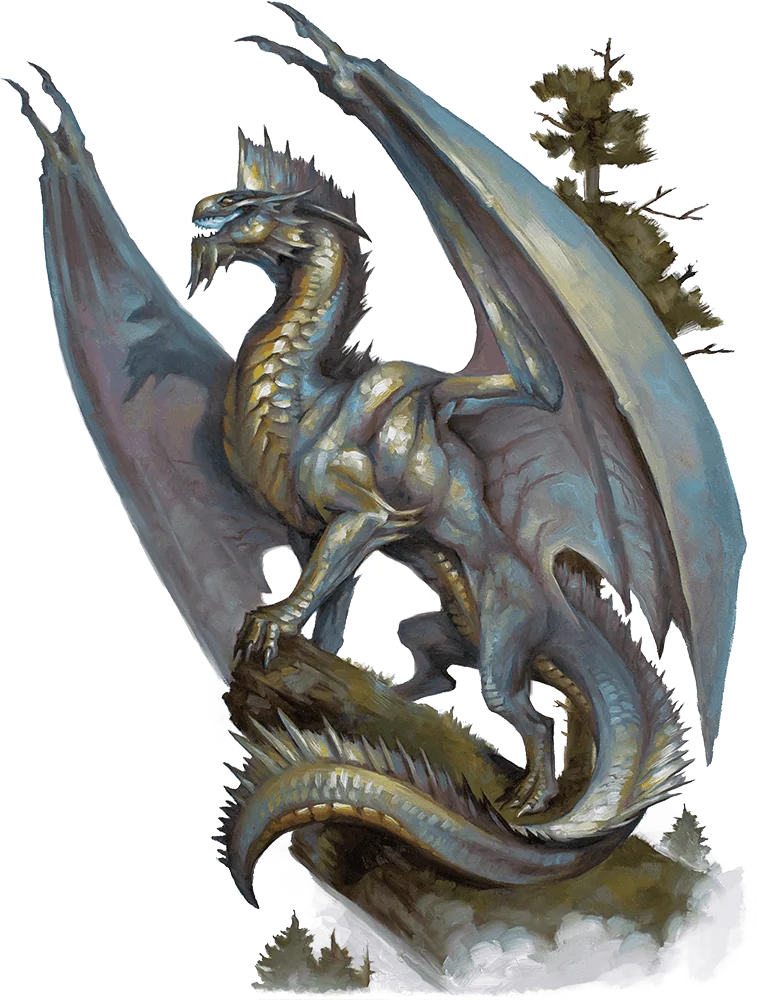
The friendliest and most social of the metallic dragons, silver dragons cheerfully assist good creatures in need. A silver dragon shimmers as if sculpted from pure metal, its face given a noble cast by its high eyes and sweeping beard-like chin spikes. A spiny frill rises high over its head, tracing down its neck to the tip of its tail. A silver wyrmling's scales are blue-gray with silver highlights. As the dragon approaches adulthood, its color gradually brightens until its individual scales are barely visible. As a silver dragon grows older, its pupils fade until its eyes resemble orbs of mercury. Dragons of Virtue. Silver dragons believe that living a moral life involves doing good deeds and ensuring that one's actions cause no undeserved harm to other sentient beings. They don't take it upon themselves to root out evil, as gold and bronze dragons do, but they will gladly oppose creatures that dare to commit evil acts or harm the innocent. Friends of the Small Races. Silver dragons enjoy the company of other silver dragons. Their only true friendships outside their own kin arise in the company of humanoids, and many silver dragons spend as much time in humanoid form as they do in draconic form. A silver dragon adopts a benign humanoid persona such as a kindly old sage or a young wanderer, and it often has mortal companions with whom it develops strong friendships. Silver dragons must step away from their humanoid lives on a regular basis, returning to their true forms to mate and rear offspring, or to tend to their hoards and personal affairs. Because many lose track of time while away, they sometimes return to find that their companions have grown old or died. Silver dragons often end up befriending several generations of humanoids within a single family as a result. Respect for Humanity. Silver dragons befriend humanoids of all races, but shorter-lived races such as humans spark their curiosity in a way the longer-lived elves and dwarves don't. Humans have a drive and zest for life that silver dragons find fascinating. Hoarding History. Silver dragons love to possess relics of humanoid history. This includes the great piles of coins they covet, minted by current and fallen humanoid empires, as well as art objects and fine jewelry crafted by numerous races. Other treasures that make up their hoards can include intact ships, the remains of kings and queens, thrones, the crown jewels of ancient empires, inventions and contraptions, and monoliths carried from the ruins of fallen cities. A Silver Dragon's Lair[−]Silver dragons dwell among the clouds, making their lairs on secluded cold mountain peaks. Though many are comfortable in natural cavern complexes or abandoned mines, silver dragons covet the lost outposts of humanoid civilization. An abandoned mountaintop citadel or a remote tower raised by a long-dead wizard is the sort of lair that every silver dragon dreams of. Lair Actions. On initiative count 20 (losing initiative ties), the dragon takes a lair action to cause one of the following effects:
Additional Lair Action. At your discretion, a legendary (adult or ancient) silver dragon can use the following additional lair action while in its lair:
Regional Effects. The region containing a legendary silver dragon's lair is warped by the dragon's magic, which creates one or more of the following effects.
If the dragon dies, changed weather reverts to normal, as described in the spell, and the other effects fade in 1d10 days. Metallic Dragons[−]Metallic dragons seek to preserve and protect, viewing themselves as one powerful race among the many races that have a place in the world. Noble Curiosity. Metallic dragons covet treasure as do their evil chromatic kin, but they aren't driven as much by greed in their pursuit of wealth. Rather, metallic dragons are driven to investigate and collect, taking unclaimed relics and storing them in their lairs. A metallic dragon's treasure hoard is filled with items that reflect its persona, tell its history, and preserve its memories. Metallic dragons also seek to protect other creatures from dangerous magic. As such, powerful magic items and even evil artifacts are sometimes secreted away in a metallic dragon's hoard. A metallic dragon can be persuaded to part with an item in its hoard for the greater good. However, another creature's need for or right to the item is often unclear from the dragon's point of view. A metallic dragon must be bribed or otherwise convinced to part with the item. Solitary Shapeshifters. At some point in their long lives, metallic dragons gain the magical ability to assume the forms of humanoids and beasts. When a dragon learns how to disguise itself, it might immerse itself in other cultures for a time. Some dragons are too shy or paranoid to stray far from their lairs and their treasure hoards, but bolder dragons love to wander city streets in humanoid form, taking in the local culture and cuisine, and amusing themselves by observing how the smaller races live. Some metallic dragons prefer to stay as far away from civilization as possible so as to not attract enemies. However, this means that they are often far out of touch with current events. The Persistence of Memory. Metallic dragons have long memories, and they form opinions of humanoids based on previous contact with related humanoids. Good dragons can recognize humanoid bloodlines by smell, sniffing out each person they meet and remembering any relatives they have come into contact with over the years. A gold dragon might never suspect duplicity from a cunning villain, assuming that the villain is of the same mind and heart as a good and virtuous grandmother. On the other hand, the dragon might resent a noble paladin whose ancestor stole a silver statue from the dragon's hoard three centuries before. King of Good Dragons. The chief deity of the metallic dragons is Bahamut, the Platinum Dragon. He dwells in the Seven Heavens of Mount Celestia, but often wanders the Material Plane in the magical guise of a venerable human male in peasant robes. In this form, he is usually accompanied by seven golden canaries-actually seven ancient gold dragons in polymorphed form. Bahamut seldom interferes in the affairs of mortal creatures, though he makes exceptions to help thwart the machinations of Tiamat the Dragon Queen and her evil brood. Good-aligned clerics and paladins sometimes worship Bahamut for his dedication to justice and protection. As a lesser god, he has the power to grant divine spells. Dragons[−]True dragons are winged reptiles of ancient lineage and fearsome power. They are known and feared for their predatory cunning and greed, with the oldest dragons accounted as some of the most powerful creatures in the world. Dragons are also magical creatures whose innate power fuels their dreaded breath weapons and other preternatural abilities. Many creatures, including wyverns and dragon turtles, have draconic blood. However, true dragons fall into the two broad categories of chromatic and metallic dragons. The black, blue, green, red, and white dragons are selfish, evil, and feared by all. The brass, bronze, copper, gold, and silver dragons are noble, good, and highly respected by the wise. Though their goals and ideals vary tremendously, all true dragons covet wealth, hoarding mounds of coins and gathering gems, jewels, and magic items. Dragons with large hoards are loath to leave them for long, venturing out of their lairs only to patrol or feed. True dragons pass through four distinct stages of life, from lowly wyrmlings to ancient dragons, which can live for over a thousand years. In that time, their might can become unrivaled and their hoards can grow beyond price.
| ||||||||||||||||||||